Animal Feed Enzymes for Poultry Feed: Process Guide
Process guide for poultry enzyme feed: phytase, xylanase, mannanase selection, pelleting limits, QC, dosage, supplier checks, and cost-in-use.
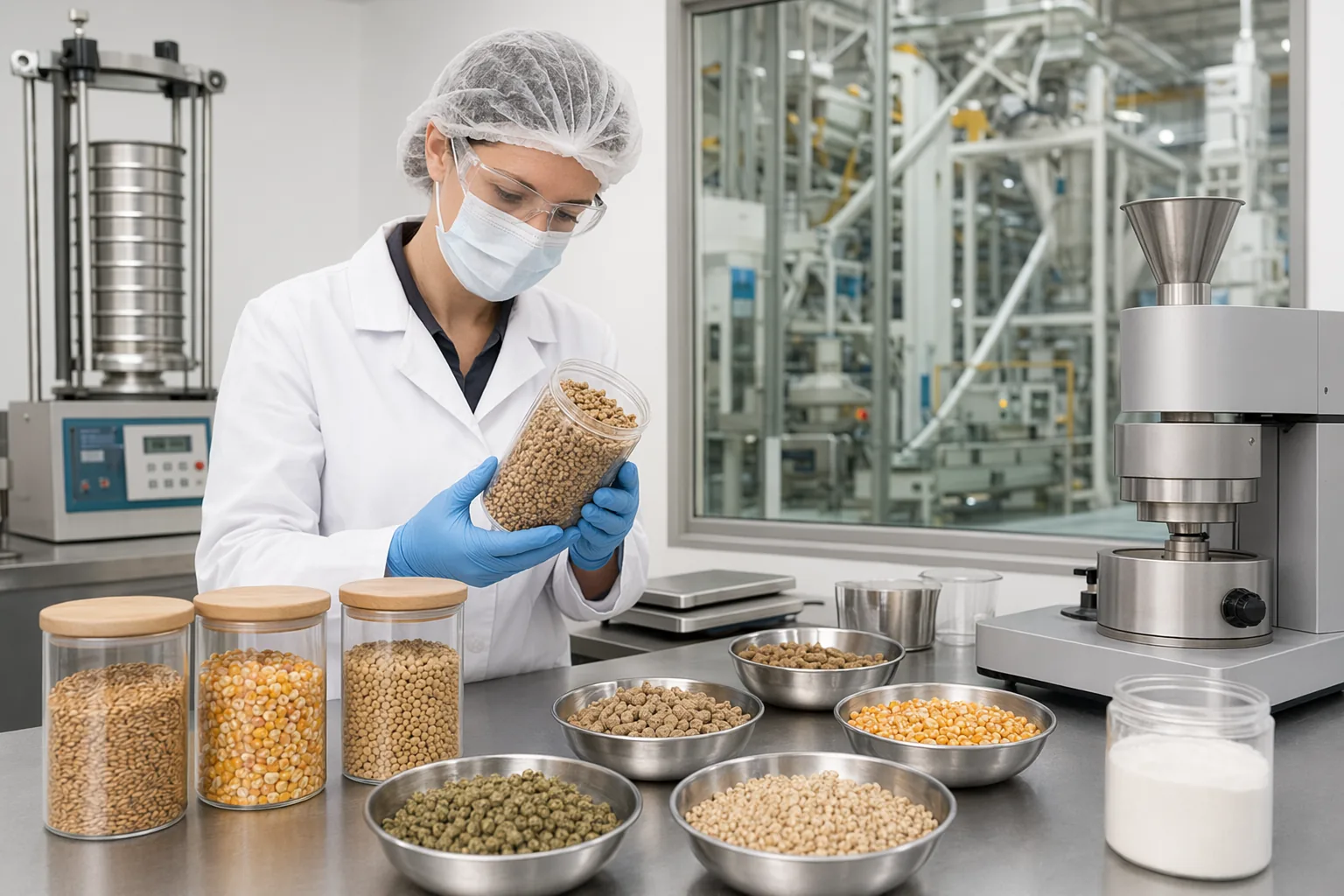
A practical B2B guide for selecting, validating, and purchasing enzyme feed additives for broiler, layer, and breeder rations.
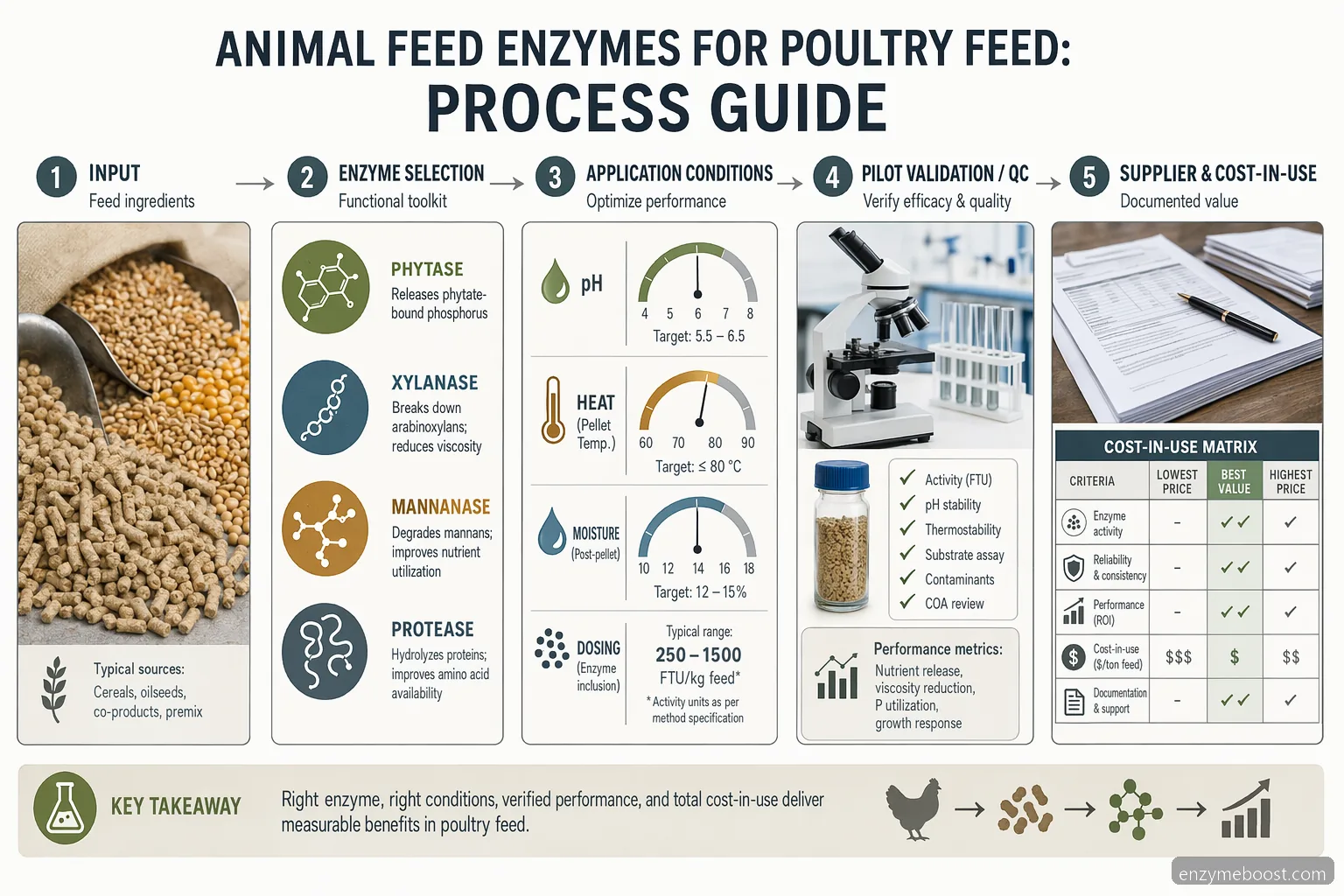
Where Enzyme Feed Fits in Poultry Nutrition
In poultry feed, enzyme feed additives are used to improve access to nutrients already present in corn, wheat, soybean meal, rice bran, and alternative plant-based ingredients. The most common feed enzymes include phytase for phytate phosphorus release, xylanase for arabinoxylan-rich grains, beta-glucanase for barley or viscous cereals, protease for protein digestibility support, and mannanase enzyme in poultry feed for soybean meal and other mannan-containing materials. A feed multi-enzyme approach may be appropriate when the formula contains several anti-nutritional substrates, but the enzyme mix should be selected by substrate mapping rather than by label count. For B2B buyers, the goal is not a generic wellness claim; it is a controlled formulation decision tied to feed conversion ratio, nutrient matrix savings, litter quality, ingredient flexibility, and reliable manufacturing performance.
Start with ingredient substrate analysis, not only enzyme activity names. • Separate broiler starter, grower, finisher, layer, and breeder objectives. • Confirm whether the product is intended for mash, pellet, crumble, or liquid post-pellet use.
Selecting Phytase, Xylanase, Mannanase, and Protease
Selection begins with the limiting substrate and the commercial value of releasing it. Phytase feed applications typically target phytate phosphorus and associated calcium, amino acid, and energy matrix contributions; performance depends on phytate level, calcium ratio, pH profile, and enzyme recovery after pelleting. Xylanase poultry feed applications are most useful in wheat, rye, triticale, and high-arabinoxylan corn coproduct diets, where viscosity and cell-wall encapsulation reduce nutrient access. Mannanase is selected when soybean meal, palm kernel meal, copra meal, or guar-related substrates contribute soluble mannans. Protease may be considered when protein digestibility variation is costly or when reducing crude protein while maintaining amino acid supply. Where feather meal supplies part of the protein, a Japanese-language application page describes keratinase for feather meal. Ask suppliers for activity units defined by method, because units are not automatically comparable across manufacturers. Review feed enzyme news and plant based feed enzyme market updates, but base purchasing decisions on your own diet economics and trial data.
Phytase: evaluate FTU activity, pH activity curve, and matrix recommendation. • Xylanase: match to soluble and insoluble arabinoxylan content. • Mannanase: verify activity on relevant beta-mannan substrates. • Protease: assess compatibility with amino acid formulation strategy.
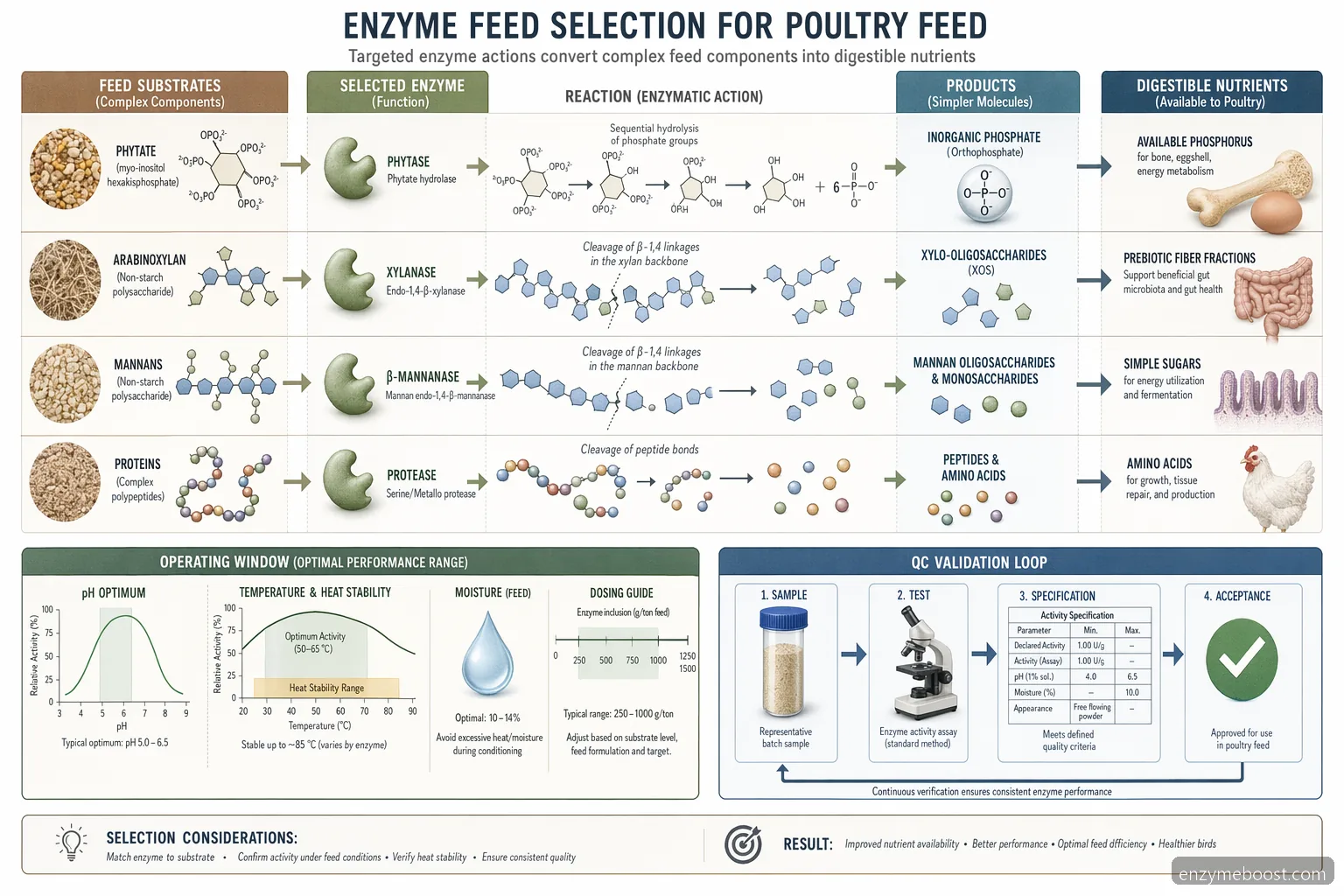
Process Conditions: pH, Heat, Moisture, and Dosing
Poultry digestive pH varies by segment, so enzyme activity across acidic to near-neutral ranges matters. Many phytases are designed to work around pH 2.5 to 5.5, while xylanase, mannanase, and protease products often show useful activity between pH 4.0 and 6.5, depending on source and formulation. During feed manufacture, conditioning commonly occurs near 75 to 90°C for 20 to 60 seconds, but high steam, long retention, and frictional heat can reduce enzyme recovery. Granulated thermostable products may tolerate pelleting better than unprotected powders; liquid enzymes are often applied post-pellet when uniform spraying is available. Typical commercial dosage bands may range from 250 to 2,000 FTU/kg for phytase, 8,000 to 32,000 BXU/kg for xylanase, and supplier-specific ppm or activity-unit levels for mannanase and protease. Confirm dosage against the supplier TDS and your feed formulation matrix.
Record conditioner temperature, retention time, moisture, and pellet mill load. • Measure enzyme recovery after pelleting, not only before conditioning. • Avoid comparing dosage rates without comparing activity methods.
Pilot Validation and QC Before Full-Scale Adoption
Pilot validation should mirror commercial production as closely as possible. Run the candidate animal feed enzyme through the same mixer sequence, fat addition point, conditioning temperature, die configuration, and finished-feed storage conditions used in routine poultry feed production. Sampling should include premix, mash, conditioned meal if available, pellets or crumbles, and retained feed after storage. QC checks may include enzyme activity recovery, coefficient of variation for mixing uniformity, pellet durability index, moisture, bulk density, microbial indicators where required, and nutrient confirmation for phosphorus, calcium, protein, or fiber fractions. Bird performance trials should include a positive control, negative control, and enzyme treatment with a defined nutrient matrix. Evaluate feed intake, body weight gain, FCR, livability, litter observation, and economic return. A feed enzyme alliance, consultant, or nutrition partner can help design the protocol, but ownership of final validation should remain with the feed manufacturer.
Use retained samples for dispute resolution and stability review. • Define acceptance criteria before the trial starts. • Compare both biological response and manufacturing practicality.
Supplier Qualification, Documentation, and Cost-in-Use
A qualified enzyme feed additive supplier should provide consistent technical documentation before quoting only on price. Request a current certificate of analysis for each batch, technical data sheet with activity definition and recommended inclusion, safety data sheet, allergen or handling information where relevant, storage guidance, shelf-life data, packaging details, and traceability format. Ask for stability data in mash, pelleted, and stored feed, plus compatibility guidance for acids, minerals, coccidiostats, probiotics, and other common additives. Cost-in-use should include enzyme dose, nutrient matrix value, expected recovery after processing, freight, inventory losses, dosing equipment, and analytical verification. Lowest price per kilogram may be misleading if activity concentration, recovery, or matrix support is weak. Buyers should also assess response time, regulatory support for target markets, lot-to-lot consistency, and willingness to support pilot validation without overstating performance claims.
Require COA, TDS, SDS, and batch traceability for every approved product. • Audit supplier change-control procedures for strain, carrier, and formulation changes. • Calculate delivered cost per metric ton of finished feed, not only product price.
Technical Buying Checklist
Buyer Questions
Start with the diet substrate, not the product name. Review grain type, soybean meal level, phytate phosphorus, soluble fiber, protein variability, pelleting temperature, and target performance metric. Then shortlist feed enzymes with documented activity methods and stability data. Run a controlled pilot using your own formulation and processing conditions before adopting any nutrient matrix or changing the feed specification.
Yes, phytase and xylanase are commonly combined when the diet contains both phytate and arabinoxylan substrates. The decision should be based on additive economic value, not assumption. Confirm compatibility in premix or finished feed, expected activity recovery after pelleting, and the formulation matrix used by the nutritionist. A trial with positive and negative controls helps separate enzyme response from normal flock variation.
Request a COA for the supplied batch, TDS, SDS, activity assay method, storage and shelf-life guidance, packaging details, traceability system, and any application data relevant to poultry feed processing. For supplier qualification, also ask about change control, lot-to-lot consistency, analytical support, and how the supplier handles technical complaints. Documentation should support safe handling and repeatable manufacturing decisions.
Cost-in-use combines the delivered enzyme price, inclusion rate, activity concentration, processing recovery, dosing losses, analytical testing, and any nutrient matrix value accepted by the nutritionist. Buyers should compare finished-feed cost per metric ton and flock economics, not only price per kilogram. A product with better heat stability or validated matrix support may have a lower practical cost than a cheaper alternative.
Feed-Grade Enzyme Blends for Research & Industry
Need Feed-Grade Enzyme Blends for your lab or production process?
ISO 9001 certified · Food-grade & research-grade · Ships to 80+ countries
Frequently Asked Questions
How should a poultry producer choose an enzyme feed additive?
Start with the diet substrate, not the product name. Review grain type, soybean meal level, phytate phosphorus, soluble fiber, protein variability, pelleting temperature, and target performance metric. Then shortlist feed enzymes with documented activity methods and stability data. Run a controlled pilot using your own formulation and processing conditions before adopting any nutrient matrix or changing the feed specification.
Can phytase and xylanase be used together in poultry feed?
Yes, phytase and xylanase are commonly combined when the diet contains both phytate and arabinoxylan substrates. The decision should be based on additive economic value, not assumption. Confirm compatibility in premix or finished feed, expected activity recovery after pelleting, and the formulation matrix used by the nutritionist. A trial with positive and negative controls helps separate enzyme response from normal flock variation.
What documents should industrial buyers request from a feed enzyme supplier?
Request a COA for the supplied batch, TDS, SDS, activity assay method, storage and shelf-life guidance, packaging details, traceability system, and any application data relevant to poultry feed processing. For supplier qualification, also ask about change control, lot-to-lot consistency, analytical support, and how the supplier handles technical complaints. Documentation should support safe handling and repeatable manufacturing decisions.
How is cost-in-use calculated for an enzyme formulation for poultry feed?
Cost-in-use combines the delivered enzyme price, inclusion rate, activity concentration, processing recovery, dosing losses, analytical testing, and any nutrient matrix value accepted by the nutritionist. Buyers should compare finished-feed cost per metric ton and flock economics, not only price per kilogram. A product with better heat stability or validated matrix support may have a lower practical cost than a cheaper alternative.
Ready to source?
Request a poultry enzyme feed evaluation with COA, TDS, SDS, pilot protocol, and cost-in-use support. To request a quote, send the product, the quantity and the destination.
Contact Us to Contributehello@mail.enzymeboost.com