Animal Feed Enzymes: Specification Checklist for Poultry Feed Buyers
Compare animal feed enzymes for poultry feed with specification, QC, dosage, validation, cost-in-use, and supplier qualification checkpoints.
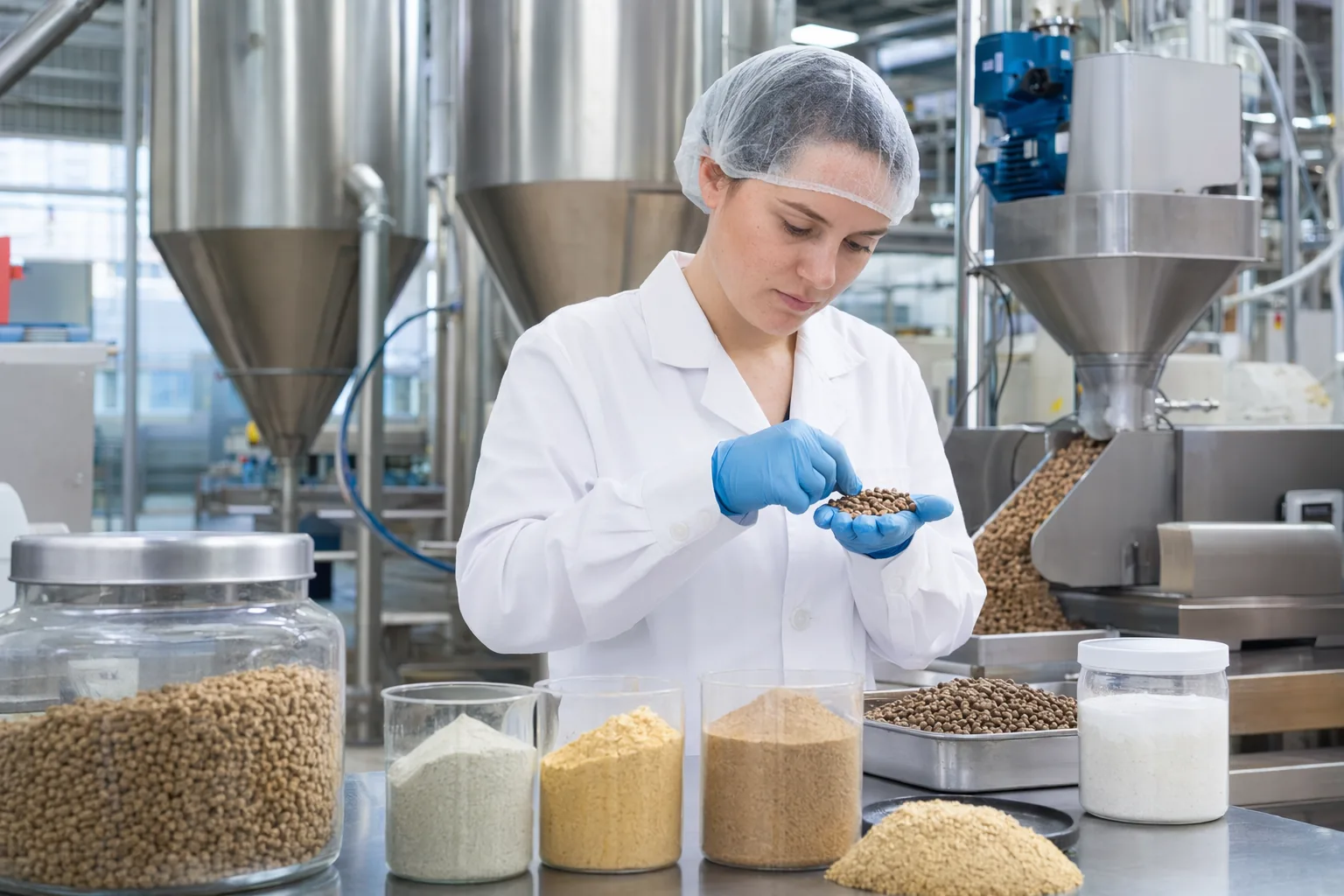
A practical B2B guide for comparing feed enzymes, validating supplier data, and selecting enzyme systems for poultry feed production.
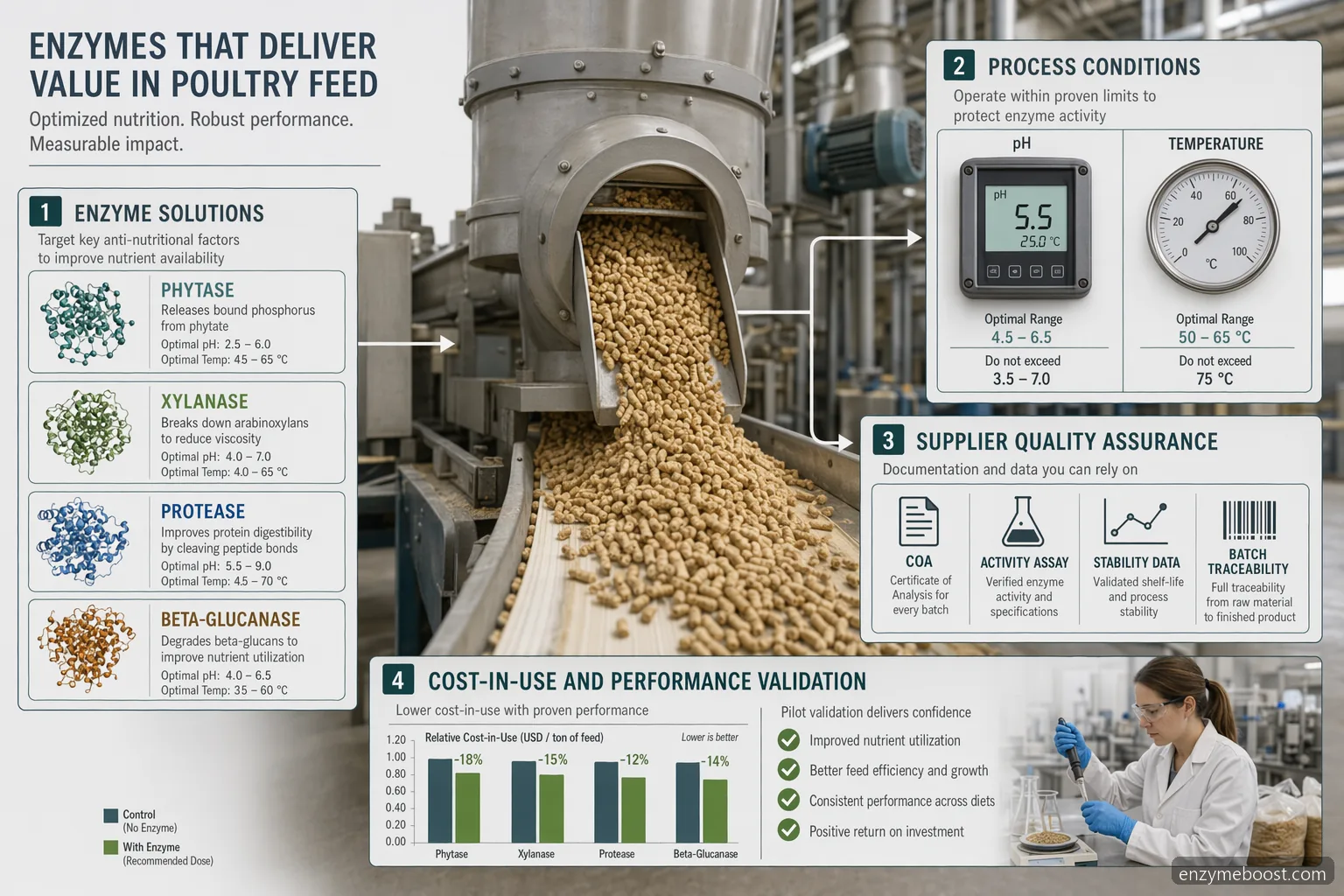
How to compare animal feed enzymes for poultry feed
For poultry feed manufacturers, animal feed enzymes should be compared by technical fit, process survivability, analytical transparency, and economic return. The use of enzymes in animal feed is usually intended to improve access to nutrients bound in common raw materials such as corn, wheat, soybean meal, rice bran, barley, and canola meal. A phytase feed product may target phosphorus release, while xylanase poultry feed applications usually focus on non-starch polysaccharides in wheat- or corn-based diets. Protease, amylase, beta-glucanase, and multi-enzyme systems may be considered when raw material variability or digestibility constraints affect formulation. Buyers should avoid generic comparisons based only on declared activity. Instead, assess enzyme activity units, analytical method, substrate specificity, thermostability, pH activity profile, matrix value assumptions, and recovered activity after pelleting. This approach supports better purchasing decisions in the animal feed enzymes industry.
Define the target substrate in the diet before selecting an enzyme. • Compare declared activity only when the assay method is equivalent. • Check pelleting and storage stability under your actual process conditions. • Evaluate performance by cost-in-use, not only unit price.
Core enzyme types used in poultry feed
When buyers ask what enzymes are used to make animal feed, the answer depends on diet composition and production goals. Phytase is commonly used to release phytate-bound phosphorus and may reduce reliance on inorganic phosphorus when supported by formulation data. Xylanase is widely assessed in poultry diets containing wheat, corn, rye, or by-products rich in arabinoxylans. Beta-glucanase is relevant in barley- or oat-containing diets, where beta-glucans can affect viscosity. Protease may support protein digestibility, while amylase is considered when starch utilization is a limiting factor. Multi-enzyme blends can be useful, but they should not be treated as automatically superior. Buyers should confirm whether each active component contributes under the feed’s pH, temperature, and substrate conditions. For broilers and layers, activity in the approximate gastrointestinal pH range of 2.5 to 6.5 is often important, depending on enzyme type and release profile.
Phytase: targets phytate-bound phosphorus. • Xylanase: targets arabinoxylans in cereal-based diets. • Beta-glucanase: targets beta-glucans in barley and oat ingredients. • Protease and amylase: support protein and starch utilization where justified.
Process conditions that affect enzyme recovery
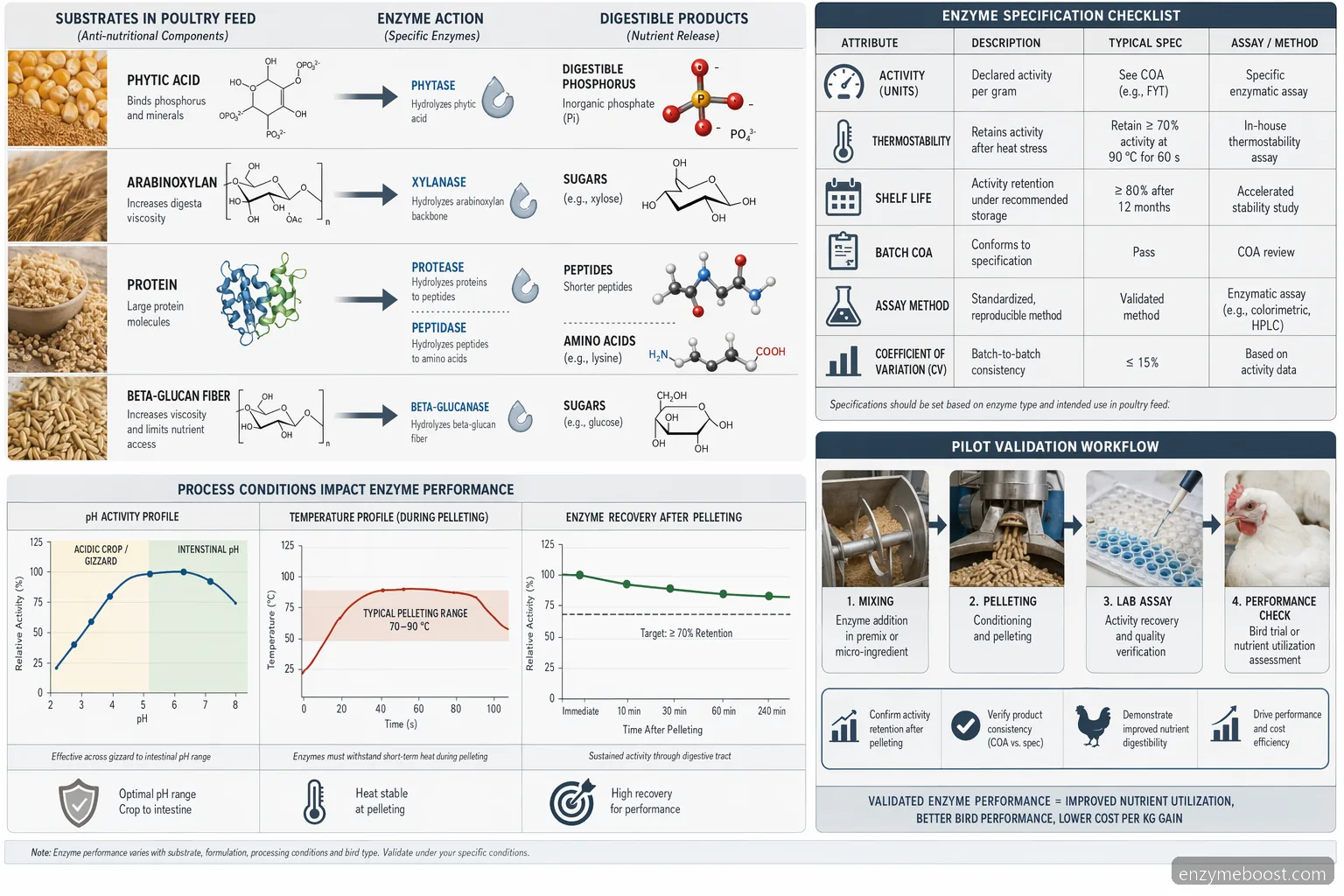
Enzymes for animal feed must survive the conditions used in commercial feed production. Poultry feed pelleting commonly exposes mash to conditioning temperatures around 75 to 90°C, with some operations running higher depending on hygiene and pellet quality requirements. Steam quality, conditioning time, moisture, die friction, and cooling can all influence recovered activity. Thermostable granulated products may tolerate pelleting better than standard powders, while liquid enzymes may be applied post-pellet to reduce heat exposure. However, post-pellet application requires accurate dosing, spray coverage, mixing control, and microbial management. Buyers should ask suppliers for recovery data generated under comparable temperature and retention-time conditions, not only laboratory thermal curves. Practical QC should include enzyme activity testing before and after pelleting, moisture checks, bulk density, flowability, and homogeneity. These data help distinguish robust animal feed enzyme options from products that perform only under idealized conditions.
Typical mash conditioning: about 75 to 90°C, depending on operation. • Relevant feed pH activity range is often about 2.5 to 6.5. • Validate recovered activity after pelleting, not just initial activity. • For liquids, confirm spray accuracy, coverage, and tank stability.
Documents and QC data to request from suppliers
Supplier documentation is central to qualification in the enzymes in animal feed industry. Before commercial purchasing, request a current Certificate of Analysis, Technical Data Sheet, and Safety Data Sheet for each animal feed enzyme product. The COA should identify batch number, activity result, specification limit, test method, manufacture or retest date, and relevant physical or microbiological parameters where applicable. The TDS should explain activity units, recommended dosage bands, carrier system, storage conditions, shelf life, compatibility notes, and handling guidance. The SDS should support safe warehousing and worker protection. For imported or high-volume supply, buyers should also review traceability, change-control process, allergen or sensitization statements, contaminant testing approach, and packaging integrity. Do not rely on broad claims without method details. A qualified supplier should explain how activity is measured and how results correlate with practical feed manufacturing conditions.
Request COA, TDS, SDS, and batch traceability. • Confirm activity method and unit definition. • Review shelf life, storage temperature, and packaging integrity. • Ask about change notification for formulation or production changes.
Pilot validation and cost-in-use comparison
The animal feed enzymes market includes many products with similar headline claims, so pilot validation is essential. Start with a small production trial using representative raw materials, normal grinding, mixing, conditioning, pelleting, cooling, and storage conditions. Dose within the supplier’s recommended band, often expressed as grams per metric ton or activity units per kilogram of finished feed. For phytase, xylanase, and other enzyme systems, compare expected matrix values with measured feed analysis, recovered enzyme activity, pellet quality, animal performance indicators where available, and formulation savings. Cost-in-use should include enzyme price, inclusion rate, application equipment, QC testing, wastage, freight, storage losses, and any formulation credit. A lower-cost product may be less economical if it requires higher dosage or loses activity during pelleting. A structured trial helps purchasing, nutrition, and production teams compare enzymes in animal feed on evidence rather than assumptions.
Run trials under normal plant conditions, not only lab conditions. • Track inclusion rate, recovery, pellet quality, and formulation value. • Calculate cost per metric ton of finished feed. • Include equipment, QC, freight, and storage factors in cost-in-use.
Supplier qualification checklist for industrial buyers
A strong animal feed enzyme supplier should support technical comparison, regulatory review, plant trials, and repeatable delivery. Qualification should cover manufacturing consistency, analytical capability, documentation responsiveness, application support, and logistics reliability. Ask whether the supplier can provide representative samples from commercial batches, not only special trial lots. Confirm minimum order quantity, lead time, storage conditions, packaging options, and product stability during transport. For poultry feed applications, suppliers should be able to discuss phytase feed strategy, xylanase poultry feed use cases, dosage flexibility, and compatibility with minerals, acids, premixes, and heat treatment. They should also be transparent about limits: no enzyme works equally well in every formulation or process. Avoid suppliers that provide vague dosage claims, missing COA data, or unsupported performance guarantees. The best comparison is based on documented specifications, validated plant data, and clear commercial terms.
Verify documentation speed and technical support quality. • Ask for commercial-batch samples for pilot testing. • Confirm lead time, MOQ, packaging, and storage requirements. • Require transparent limits instead of universal performance claims.
Technical Buying Checklist
Buyer Questions
Animal feed enzymes are used to help release nutrients from feed ingredients that poultry may not fully access without enzymatic support. In commercial poultry feed, phytase, xylanase, beta-glucanase, protease, and amylase are commonly evaluated. The goal is usually formulation efficiency, nutrient availability, and more consistent use of variable raw materials. Selection should be based on substrate, process conditions, dosage, and validated cost-in-use.
Compare phytase feed products by declared activity, assay method, pH activity profile, thermal stability, recommended matrix values, and recovered activity after pelleting. Request COA, TDS, SDS, and plant-relevant recovery data. A higher declared activity does not automatically mean better value if the assay method differs or if activity loss occurs during conditioning and pelleting. Pilot validation is recommended before commercial inclusion.
For xylanase poultry feed use, first confirm that the diet contains relevant arabinoxylan substrates, such as those from wheat, corn, rye, or certain by-products. Then compare enzyme activity method, pH performance, thermostability, dosage range, and evidence from similar feed matrices. Buyers should also check compatibility with premixes, acids, minerals, and pelleting conditions. Recovered enzyme activity after processing is a key QC checkpoint.
No. This page is for B2B buyers evaluating industrial enzymes in animal feed for poultry feed manufacturing. The search phrase what to feed a dog with high liver enzymes relates to veterinary nutrition and should be handled by a licensed veterinarian. Feed enzyme purchasing decisions for poultry plants involve specifications, COA, TDS, SDS, processing stability, pilot trials, and commercial cost-in-use.
A supplier should provide a Certificate of Analysis, Technical Data Sheet, Safety Data Sheet, batch traceability, storage guidance, shelf-life information, and activity test method details. For supplier qualification, buyers may also request commercial-batch samples, change-control procedures, logistics information, and contaminant or microbiological testing approach where relevant. Documentation should be specific to the product and batch, not limited to generic marketing statements.
Cost-in-use is calculated by considering more than the purchase price per kilogram. Include dosage per metric ton, enzyme activity recovery, formulation credit, application equipment, QC testing, freight, storage stability, wastage, and production impact. A product with a higher invoice price may be more economical if it is effective at a lower inclusion rate or retains more activity through pelleting.
Feed-Grade Enzyme Blends for Research & Industry
Need Feed-Grade Enzyme Blends for your lab or production process?
ISO 9001 certified · Food-grade & research-grade · Ships to 80+ countries
Frequently Asked Questions
What are animal feed enzymes used for in poultry feed?
Animal feed enzymes are used to help release nutrients from feed ingredients that poultry may not fully access without enzymatic support. In commercial poultry feed, phytase, xylanase, beta-glucanase, protease, and amylase are commonly evaluated. The goal is usually formulation efficiency, nutrient availability, and more consistent use of variable raw materials. Selection should be based on substrate, process conditions, dosage, and validated cost-in-use.
How should buyers compare phytase feed products?
Compare phytase feed products by declared activity, assay method, pH activity profile, thermal stability, recommended matrix values, and recovered activity after pelleting. Request COA, TDS, SDS, and plant-relevant recovery data. A higher declared activity does not automatically mean better value if the assay method differs or if activity loss occurs during conditioning and pelleting. Pilot validation is recommended before commercial inclusion.
What should be checked for xylanase poultry feed applications?
For xylanase poultry feed use, first confirm that the diet contains relevant arabinoxylan substrates, such as those from wheat, corn, rye, or certain by-products. Then compare enzyme activity method, pH performance, thermostability, dosage range, and evidence from similar feed matrices. Buyers should also check compatibility with premixes, acids, minerals, and pelleting conditions. Recovered enzyme activity after processing is a key QC checkpoint.
Is this related to what to feed a dog with high liver enzymes?
No. This page is for B2B buyers evaluating industrial enzymes in animal feed for poultry feed manufacturing. The search phrase what to feed a dog with high liver enzymes relates to veterinary nutrition and should be handled by a licensed veterinarian. Feed enzyme purchasing decisions for poultry plants involve specifications, COA, TDS, SDS, processing stability, pilot trials, and commercial cost-in-use.
What documents should an animal feed enzyme supplier provide?
A supplier should provide a Certificate of Analysis, Technical Data Sheet, Safety Data Sheet, batch traceability, storage guidance, shelf-life information, and activity test method details. For supplier qualification, buyers may also request commercial-batch samples, change-control procedures, logistics information, and contaminant or microbiological testing approach where relevant. Documentation should be specific to the product and batch, not limited to generic marketing statements.
How is cost-in-use calculated for enzymes in animal feed?
Cost-in-use is calculated by considering more than the purchase price per kilogram. Include dosage per metric ton, enzyme activity recovery, formulation credit, application equipment, QC testing, freight, storage stability, wastage, and production impact. A product with a higher invoice price may be more economical if it is effective at a lower inclusion rate or retains more activity through pelleting.
Related: Enzyme Solutions for Liver-Support Pet Diets
Turn This Guide Into a Supplier Brief Request animal feed enzyme specifications, samples, and pilot support for your poultry feed process. See our application page for Enzyme Solutions for Liver-Support Pet Diets at /applications/liver-support-pet-food-enzymes/ for specs, MOQ, and a free 50 g sample.
Contact Us to Contribute